
Feet to Linear Feet Calculator
Linear feet measure length only — the running length of a board, trim, fence or roll, regardless of width. Enter the area to cover and the width of the material to convert square feet to linear feet, see how many boards of a given length you need with a waste allowance, or convert linear feet of lumber to board feet.
- Free to use
- No sign-up
- Runs in your browser
Quick answer
To convert square feet to linear feet, divide the area by the material’s covering width in feet. If width is in inches, use: linear feet = square feet × 12 ÷ width in inches. For board feet to linear feet, use: linear feet = board feet × 12 ÷ thickness in inches ÷ width in inches.
Linear feet calculator
Lumber & Materials Estimator Workbook
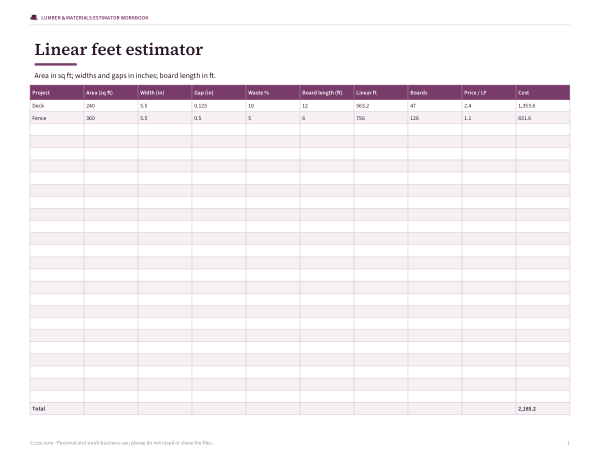
Excel estimator for decking, flooring, fencing and trim (linear feet, pieces, waste and cost), a board feet calculator, a nominal vs actual size chart and a cut list template.
- Materials estimator (XLSX)
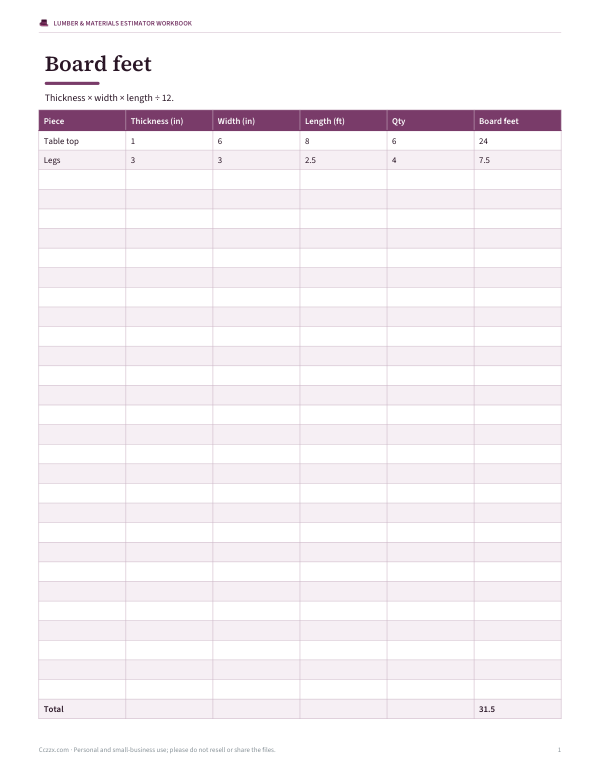
- Board feet calculator (XLSX)
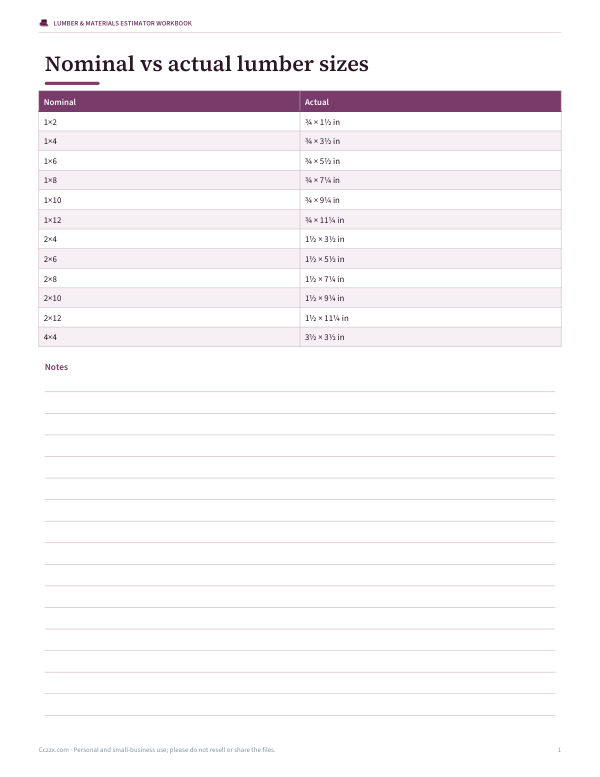
- Lumber size chart (PDF)
- Cut list (PDF, XLSX)
Formats: XLSX, PDF. Instant download after payment (link valid 72 hours, up to 5 downloads). AI-assisted: the templates were drafted with AI help and reviewed and laid out before publishing.
$4.00 USD, one-time 4 files · about $1.00 each
- Instant download
- 7-day refund
- Secure checkout by Stripe
7-day money-back guarantee. Full refund within 7 days of purchase, even after you download.
Free sample: Board Feet Calculator (PDF, 59 KB)
Full refund within 7 days — see the refund policy and license.
Free printables
Single sheets you can print right now, no sign-up. The full pack adds every sheet in one download plus the editable files.
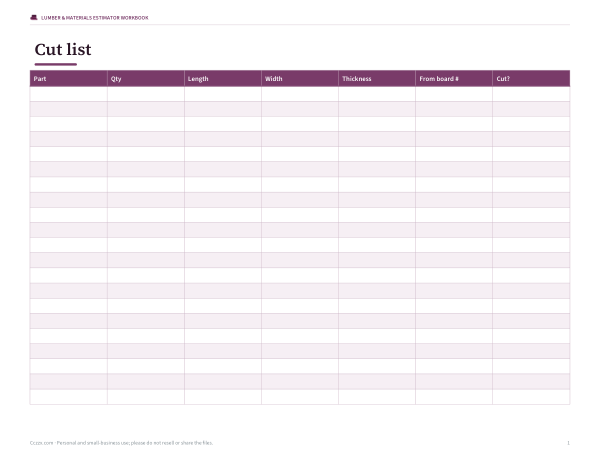 Printable Cut List
Square Feet to Linear Feet Examples
These examples show linear feet needed to cover 100 sq ft before waste.
| Material width | Width in feet | Formula | Linear feet |
|---|---|---|---|
| 3.25 in flooring | 0.271 ft | 100 ÷ 0.271 | 369 ft |
| 3.5 in board | 0.292 ft | 100 ÷ 0.292 | 343 ft |
| 5.5 in board | 0.458 ft | 100 ÷ 0.458 | 218 ft |
| 5.5 in + 1/8 in gap | 0.469 ft | 100 ÷ 0.469 | 213 ft |
| 6 in material | 0.500 ft | 100 ÷ 0.500 | 200 ft |
| 12 in material | 1.000 ft | 100 ÷ 1.000 | 100 ft |
| 36 in roll | 3.000 ft | 100 ÷ 3.000 | 33.3 ft |
What “linear feet” means
A linear foot is simply a foot of length, measured along the material, whatever its width or thickness. Lumber yards price boards, trim and mouldings by the linear foot; fencing, gutters, countertops and kitchen cabinets are often quoted by the linear foot; and fabric and carpet on rolls may be sold by the linear foot or yard. Square feet, by contrast, measure area. To convert between them, you need the width of the material.
Square feet to linear feet
Convert the covering width to feet: a deck board 5.5 inches wide with a ⅛-inch gap covers 5.625 inches, or 0.469 ft. Divide the area by that width: 240 ÷ 0.469 ≈ 512 linear feet. Add waste for cuts and defects — 10% is common for straight runs, 15% for diagonal patterns — giving about 563 linear feet, or 47 boards of 12 feet.
Nominal vs actual lumber sizes
| Nominal | Actual (dressed) |
|---|---|
| 1 × 4 | ¾ × 3½ in |
| 1 × 6 | ¾ × 5½ in |
| 2 × 4 | 1½ × 3½ in |
| 2 × 6 | 1½ × 5½ in |
| 2 × 8 | 1½ × 7¼ in |
| 5/4 × 6 decking | 1 × 5½ in (approx.) |
Use the actual width for coverage calculations. For tongue-and-groove flooring or siding, use the exposed face width, not the full width including the tongue.
Board feet
Hardwood lumber is often sold by the board foot, a measure of volume equal to a board 1 inch thick, 12 inches wide and 1 foot long (144 cubic inches). Board feet = thickness (in) × width (in) × length (ft) ÷ 12. A 1 × 6 board 8 feet long is 1 × 6 × 8 ÷ 12 = 4 board feet. Rough hardwood is usually measured by nominal (rough) thickness in quarters of an inch — 4/4, 5/4, 8/4.
Trim and baseboard
For baseboard, crown moulding and other trim, measure the perimeter of the room and subtract door openings for baseboard (not for crown). A 14 × 12 ft room has a 52 ft perimeter; minus a 3 ft door opening leaves 49 ft. With 10% waste for mitre cuts, buy about 54 linear feet — for example five 12-ft lengths. Buying longer pieces reduces joints on long walls.
Waste allowance guide
| Project | Typical waste |
|---|---|
| Straight decking or flooring | 5–10% |
| Diagonal or herringbone patterns | 15–20% |
| Trim with many corners | 10–15% |
| Fencing boards | 5% |
| Reclaimed or knotty lumber | 15–25% |
Worked example: fence boards
A 60-foot fence run 6 feet high uses 5½-inch-wide pickets with ½-inch gaps. Treat the fence face as an area: 60 × 6 = 360 sq ft, but pickets run vertically, so count them instead: the fence length in inches (720) divided by the picket spacing (6 inches) gives 120 pickets of 6 feet — 720 linear feet. Adding 5% gives 126 pickets. The calculator’s area mode gives the same total when you enter 360 sq ft, width 5.5 in and gap 0.5 in.
Flooring and cladding
Hardwood flooring is usually sold by the square foot, but some suppliers price solid boards by the linear foot. Use the covering (face) width without the tongue: a 3¼-inch strip floor covers about 0.27 ft per linear foot, so 200 square feet needs about 740 linear feet before waste. Wall cladding such as shiplap works the same way with its exposed face width. Measure the room at the widest points, subtract large obstructions such as fireplaces, and add waste for cuts around doors and edges.
Fabric and rolls
Fabric, vinyl, landscape fabric and carpet on rolls are often sold by the linear foot or yard at a fixed roll width. To cover an area, divide the area by the roll width (in feet) to get linear feet, then round up to whole feet or yards. Allow extra for pattern matching and seams, and check whether the width quoted is the full width or the usable width after selvedges.
Pricing by the linear foot
When comparing prices, make sure you compare the same thing: a price per linear foot for a 1 × 6 is not comparable to one for a 1 × 8, and a price per piece must be divided by its length. Enter the price per linear foot to see the total cost for the boards you need.
Privacy
The calculator runs in your browser and stores nothing.
Frequently asked questions
How do you convert board foot to linear foot?
Use linear feet = board feet × 12 ÷ thickness in inches ÷ width in inches. For example, 10 board feet of 1 in × 6 in lumber equals 20 linear feet.
Do gaps count when converting square feet to linear feet?
For decking, fencing, and similar spaced materials, add the gap to the board width when calculating coverage. A 5.5 in board with a 1/8 in gap covers 5.625 in per row.
Is linear feet the same as length?
Yes. Linear feet measure running length only, regardless of the board, roll, trim, or material width.
How do I convert square feet to linear feet?
Divide the square feet by the material’s covering width in feet.
How many linear feet in a square foot?
It depends on width: for a 6-inch-wide board, 2 linear feet cover 1 square foot.
What is a linear foot of lumber?
One foot of length of a board of any width or thickness.
How do I calculate board feet?
Thickness (in) × width (in) × length (ft) ÷ 12.
Should I use nominal or actual width?
Actual (or exposed) width for coverage; nominal is used for board feet pricing.
Is my data stored?
No, it runs in your browser.
How many linear feet are in 100 square feet of 1×6 decking?
About 213 linear feet using the 5.5-inch actual width and a ⅛-inch gap, before waste.
What is a lineal foot?
The same as a linear foot — lineal is an older spelling.